MORE NEWS

Spotlight on our 80th Anniversary: The Thomas More Institute’s Annual Art Show

By Carol Fiedler 

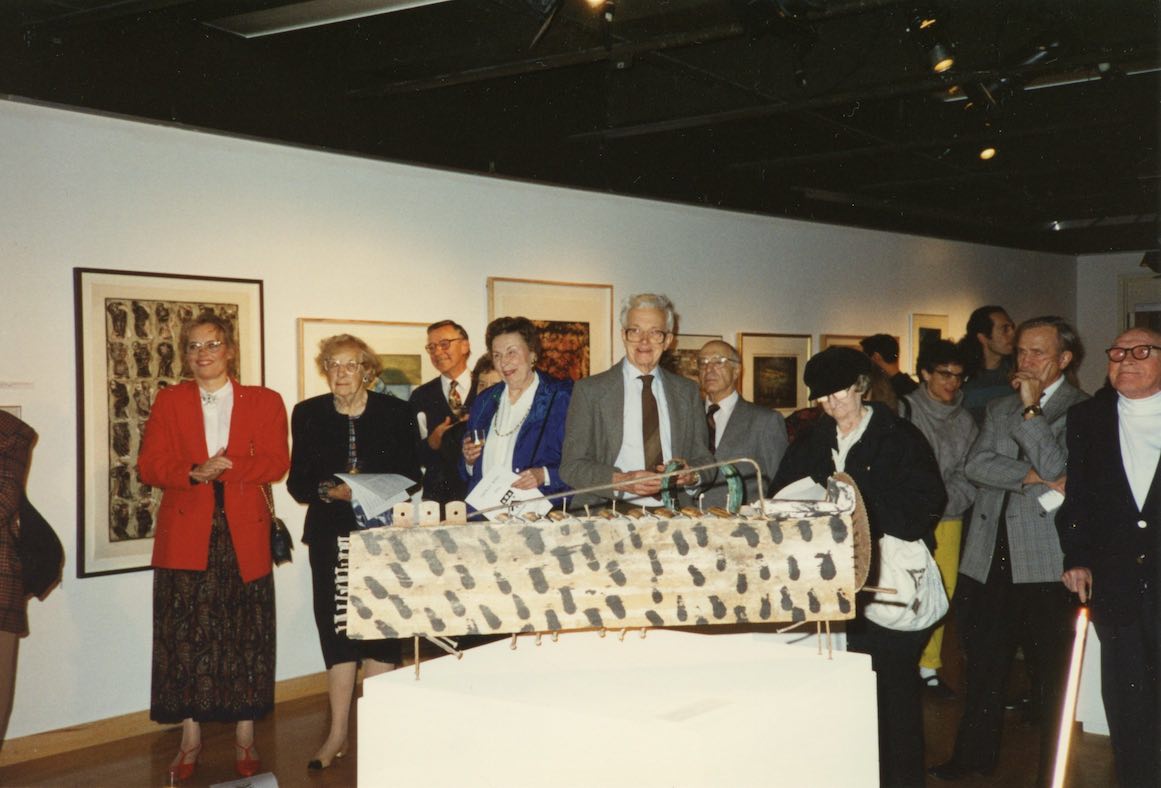
Have you ever admired the artwork that adorns the walls and shelves of the Thomas More Institute and wondered how a small non-profit academic institution acquired such beautiful works? For over forty years, from 1962 to 2008, the Thomas More Institute held an annual Exhibition and Sale of Art, organized by exceptional volunteers Martin O’Hara, Hedwidge Asselin, Uve Von Harpe, Cassie Cahoon, Tony Joseph, and others. The exhibition was known as an opportunity for young Quebec artists to show their work. Sarah Valerie Gersovitz, Tony Joseph told me, “participated in almost all of our TMI exhibitions. She was a famous and well-known Canadian artist whose name gave extra prestige to our exhibition and drew attention from other artists wanting to participate.” The exhibit also served as a fundraiser for the Institute. Should an artwork sell, a percentage of the profit would go to the Thomas More Institute, while the rest would go to the artist.

Hedwidge Asselin, who held a Ph.D. in philosophy and studied art history at the Sorbonne and McGill University, was engaged in the local art scene and knew many contemporary artists. Through her connections, the Institute was able to show important up-and-coming painters and sculptors. Quebec artists such as Louis Belzille, Sylvia Safdie, Luba Genush, and Fritz Brandtner displayed their works at the exhibition. Each show held a competition for the top prize, with the winning work purchased by the Thomas More Institute, thus contributing to its collection. The show was made possible by the hard work of the Associates, a committee of dedicated volunteers who worked to organize the academic and cultural events of the Institute (learn more about the Associates in our December 2025 edition of More News). Each year the art exhibition would be shown for ten days, often in such fine venues as the Lotto Québec premises. Lotto Québec was one of the biggest customers of the show, sometimes ordering five or more paintings. In the final exhibition in 2008, one year after her passing, several pieces of Gersovitz’s work were displayed in a separate space, in recognition of her extraordinary talent and her generosity to the Institute throughout the years.

TMI Art Show

The Times They Are A-Changin’: The Historical and Current Stakes in Immigration as Discussed with Dr. Mireille Paquet in the Thomas More Institute’s 80th Anniversary Interview Series “Encountering the Other”

By Louise Jarrett

I emigrated from England to Canada, at the beginning of my twenties, to escape Thatcherism. Ten years later I “migrated” from Toronto to Quebec, where I have lived for 42 years. Not growing up in Quebec, the place has remained something of a mystery for me. I was very pleased to attend the interview with Dr. Mireille Paquet, on March 24 (Encountering the Other: Migration and Democracy) and learn more. Apparently, Quebec has a unique and interesting history of immigration.

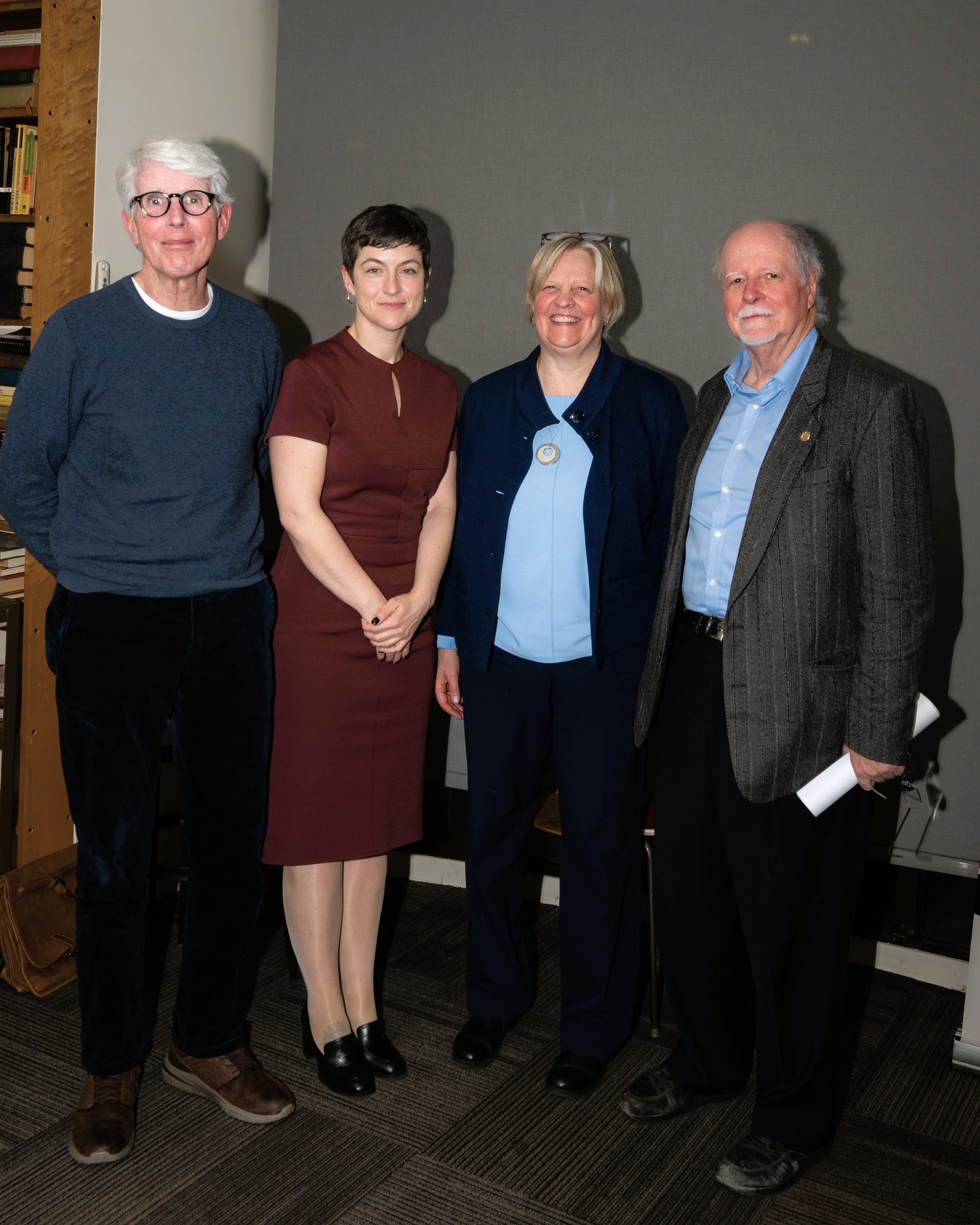
Dr. Paquet, who was interviewed by Brian McDonough and Carol Fiedler, gave a very personal and lively account of immigration in Canada, in general, and Quebec in particular. She grew up in Sherbrooke: a really homogeneous part of the province. Her first real encounter with “the Other” was when a group of Yugoslavian refugees attended her high school. It was a seminal moment that led to her studying social sciences and focusing her research on immigration. Her interest grew out of her realization that these refugees were more like her than not like her: the Other was not other but the same.

Dr. Paquet stressed that there is generally “fuzzy thinking around immigration.” The terms migrant and refugee are often confused when they should not be. While there is no clear definition of what a migrant is, this is not the case for a refugee. An Administrative Tribunal, created after WWII, decides who has refugee status according to strict criteria. These criteria have changed to now account for violence on the basis of gender and sexual orientation. However, climate change and poverty, which are major causes of human migration, are not criteria for refugee status. “Economic refugees” is a relatively new term for an age-old problem.

Canada is unique in that jurisdiction over immigration is shared by the federal and the provincial governments. No other country in the world has this arrangement. Interestingly, and not surprisingly, Quebec is unique among the provinces: it receives federal funding for the integration of its immigrants. In Quebec, immigration is a package deal: it is inseparable from integration.

In the Duplessis era, Quebec was opposed to immigration. Following the Quiet Revolution, the province became very proactive on the issue. In 1968, the Department of Immigration was created and was based, rather significantly, in Montreal, rather than Quebec City.

Dr. Paquet explained how Quebec has experienced three waves of immigration. From the sixties to the nineties there was heated debate around the subject. From the nineties to 2012 there was a period of consensus: immigration was stable but growing. With the CAQ entering the political scene in 2012 and then coming to power in 2018, there was a radical shift. In order to distinguish itself from the Liberal Party and the Parti Quebecois, the CAQ sought to reduce the number of immigrants. Unfortunately, immigration is a wedge issue dividing the province today. While polls show that immigration is not something that preoccupies voters, it is increasingly the issue being politicized by the right wing movement. Traditional, moderate parties are forced to respond to the rhetoric around immigration and in the process become fractured. The constant reiteration of immigration as an issue means that, eventually, it becomes an issue. Sadly, this is where we stand today in Quebec, in Canada and in the world at large.

There is evidence that foreign interference is using the issue of immigration to divide and conquer. Our news routinely provides more opinions than facts. As Dr. Paquet expressed it, “we are living in a media echo-system.” Immigration is now beset by policy cancellations, back-logs, delays and even AI- generated fraudulent documentation.

In the next five years Quebec will face an essential workers crisis. The demographic future of Quebec is in doubt. There is currently a 16-17 year delay for immigrants seeking to become Permanent Residents. This delay allows workers to be exploited for decades. One million residents of Quebec are about to lose their status as temporary workers. What will their fate be?

Listening to Dr. Paquet, I realized that I had been a Canadian immigrant in the Golden Age. My journey had been simple, with no roadblocks along the way. Canada is in a new, darker era now and immigration may never be straightforward again. As Democracy unravels, immigration will become a more divisive issue, but only if we allow it to.

“Encountering the Other: Migration and Democracy” event.

Did You Know? A Look Back at the Thomas More Institute Special Programs

Inaugurated in 1945, The Thomas More Institute wasted no time resting on its laurels as it moved into the 1950s. Early in the decade, it began experimenting with discussion-based courses, laying the groundwork for its signature reading-and-discussion pedagogy. The Institute also expanded its reach with courses for adults aiming to earn a high school diploma, specialized programs for teachers of young children—like Understanding, then Teaching Exceptional Children—and even a series of telephone-based discussion courses for visually impaired students.
Many of these innovations sprang from a deep commitment to responding to community needs. A good example was the Workers’ School, launched in the early 1950s, which offered union members courses on topics such as Major Issues in Labor Relations,” Legal Aspects of Labor Organization in Quebec,” and Economic and Social Reform.” A 1954 exam from a course on Industrial and Labour Legislation asked students not only to compare labor laws at the federal and provincial levels but also to identify the best features of each that should be included in an ideal labor relations act. Even with its practical orientation, the Institute’s approach consistently encouraged thoughtful reflection, challenging students to engage deeply with the pressing issues of their day.

The Medium is the Message

By Louise Jarrett

Over many decades, courses that combine literature and film have proven very popular at the Thomas More Institute. Andrew Byers has designed and led many of these, including a course on Raymond Chandler, one on Henry James and the upcoming Graham Greene on Screen. This term, Friendship Through Fiction and Film was well attended and Shakespeare in the Spring is a TMI favourite.

Including films in a course presents a particular dilemma: should the films be watched in class or should participants view them at home before discussing them? Andrew Byers believes that “watching films is a communal experience,” so he always shows the films in class. He feels that the “immediacy of watching together” makes the discussion more spontaneous. Furthermore, watching together is also “a reward for doing the required reading” and a welcome “change of pace” from the TMI discussion method.

In the Friendship Through Fiction and Film course, participants watched the films at home via a streaming service. Interestingly, some participants elected to watch together at one location. This course has been rather unique as a group of friends registered together. They not only watched the films together, but offered lots of insights into friendship as one voice. When one member of the class could not access a film, she was invited to watch with a fellow classmate. This seemed in keeping with the TMI spirit of shared learning. Happily, the one man who signed up for the course continued, despite being seriously outnumbered. We have appreciated having a male perspective on friendship.

Asking people to watch movies at home does allow for more discussion time in class. Oftentimes, it is easier to hear at home than in a classroom. In a short survey of those taking Friendship Through Fiction and Film, the majority said that they preferred watching films at home. Participants also said that they experienced no discernible difference in discussing films as opposed to novels. This suggests that today, film really is just another form of text for most people.

In the case of this course, it was the topic of friendship that attracted people, rather than the novels and films selected. The majority of members of the class had never taken a course combining fiction and film before, and were unanimous in planning to do so again.

The Shakespeare in the Spring course provides short clips from films, courtesy of YouTube, during the discussions. This creates more work for the leaders, but can really enhance understanding and student engagement. Most fiction and film courses offer film versions of the texts read. If there is more than one film version, a difficult choice lies ahead. For Andrew Byers the choice is an easy one: always choose the original version, rather than a re-make and/or the version where the author has written the script.

In Friendship Through Fiction and Film, we read three novels and watched three films on the theme of Friendship. There were also weekly supplemental readings on current research. Each text revealed different aspects of what we now understand to be an extremely complex subject.

We live in a highly visual age, so it seems likely that courses offering literature and films will continue to appeal to members of the TMI community.


Spotlight on Our 80th Anniversary: The Associates Committee and The Feast of Lights

As we approach our annual holiday gathering, we wanted to look back at the celebrations from previous years. Members of the Thomas More Institute have been coming together at a Feast of Lights celebration since the late 1980s, when a dynamic committee called the Associates, hit upon the idea of a holiday get-together as a fundraiser for the Institute.

The Associates Committee was made up of a small group of dedicated Thomas More volunteers, including Rolande Sentenne, Uve von Harpe, Cassie Cahoon, Tony Joseph, and others. This group believed in the mission of the Institute and gave their time and ingenuity to finding ways of raising money to support Thomas More, which despite its popularity, was (and is) always in need of financial resources. The Associates were best known for putting on an annual art exhibition of Québec paintings (read more about this in the next issue of More News), but they also organized the following fundraisers every year: a book fair, a spring tea, a trip to the Stratford Festival, and, starting in the late 1980s, the Feast of Lights.

The first Feast of Lights celebration took place in 1987 as Thomas More was searching for a permanent home. All attendees were invited to come to enjoy classical music played by students, delicious food prepared by community members, and the good company of fellow learners. They were also asked to bring a financial contribution to support the institute and to help fund the purchase of a new home. Once Thomas More had moved to its new premises at 3405 Atwater in 1991, the tradition continued, made easier by the availability of a party room in our new home. Tony Joseph remembers greeting Thomas More students as they arrived at the party, and receiving cash or a cheque from each one.

As the years passed, Thomas More transitioned to receiving most donations by mail, and later online, but the Feast of Lights continued, giving staff, students, leaders, and designers a chance to gather and celebrate the holidays and our common passion for lifelong learning.

In Memoriam: Erika Podesser Romwalter  

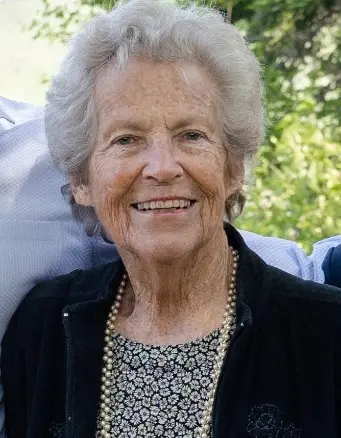
Erika Podesser Romwalter  

November 26, 1933 – November 19, 2025 

It is with sadness that we announce the death of Erika Podesser Romwalter. Erika was born in Sankt Leonhard, Austria, and resided in Chateauguay, Québec. She was a dedicated member of the Thomas More community, having earned a Comprehensive Certificate and having served as a discussion leader both at the Atwater campus for many years and in the Seniors Program at Maison Desaulniers from 2010 – 2022. She is warmly remembered by those who volunteered with her. She will be missed. You can read more about her life at:  https://www.dignitymemorial.com/en-ca/obituaries/montreal-qc/erika-podesser-12625561 


History in Motion: Thomas More’s 80th Anniversary Fundraising Walk 

On Saturday, October 18, a group of 30 enthusiastic walkers met at D’Arcy McGee High School to trace the path that the Thomas More Institute’s rich history of education has travelled in the city. From D’Arcy McGee, where classes were held for many years at the beginning of our history, to Drummond Street, the second location where the Institute rented space, to our current location at 3405 Atwater, where we finally found a permanent home, the walkers celebrated 80 years of shared inquiry with a community of engaged, curious learners. Longtime students, leaders, designers, and administrators Heather Stephens and Irene Menear spoke at the first two locations, and current Chair Carol Fiedler wrapped up the event at our Atwater classrooms.  

The walkers not only enjoyed a lovely stroll on a cool fall day, but they also prepared for the event by spreading the word about the 80th anniversary of the Institute to family and friends, asking for donations to support Thomas More. When they arrived at the Atwater campus, they were greeted with warming, delicious coffee from the B Hive Café (2313 Ste-Catherine West, located in the Montreal Forum building) and delicious sandwiches from Chez Nick (1377 Greene Avenue, a longtime favourite restaurant of Thomas More students) and tasty sandwiches, fruit, and water from les 5 saisons (1280 Greene Avenue), our three generous sponsors for the event. 

As a fundraiser, the event far surpassed our expectations. When all donations were counted, the fundraising walk had raised $17,693 from 145 generous donors, 92 of whom were new to the Thomas More Community.  

A huge thank you to the walkers and other fundraisers for their dedication to Thomas More and for their willingness to ask friends and family to support this beloved institution dedicated to lifelong learning. We also want to thank our sponsors, the B Hive Café, Chez Nick, and Les 5 saisons for their support. Thanks also to our hospitality committee (Giovanna D’Alesio, Jennifer MacGregor, and Tina Nussbaum) for creating a wonderful welcome for the walkers at Thomas More. Finally, a huge thank you to our Manager of Development, Marleigh Greaney, who had the inspiration for the event and made it happen (down to ironing the Thomas More logo onto bandanas for the walkers).  


An Intergenerational Art Morning: Interview with Artist Saeun Song

A few weeks ahead of the Intergenerational Art Morning, the Thomas More Institute had the opportunity to sit down with Saeun Song, an artist from Toronto pursuing a Ph.D. at Concordia University in Montreal. An Intergenerational Art Morning will be held at the Thomas More Institute on Saturday November 8, from 10 a.m. to 1:00 p.m. and is an activity that aims to give parents/grand-parents and children an opportunity to bond by collaborating on making works of art. Song will guide the participants in a series of child-friendly workshops, and lunch for all will be served!

What do you love about teaching art?

That’s a great question! I love teaching art because art class is very dynamic and multi-dimensional. It’s never linear, never one-dimensional. Everyone brings their own experiences and backgrounds, and their own skillset, which requires me to be more flexible and give them spontaneous directions and responses, which makes art class really abundant and makes it come alive. There are lots of different ways of working in art class, and materials [you could work with] are unlimited, so this is what I love about teaching art because there is potential and tons of possibilities.

You’ve offered workshops in Korea, China, Lebanon, and other countries. What’s something you learned from interacting with kids from around the world?

My work is community-oriented, so I’ve worked and taught in many different countries, especially in under-privileged areas, where the concept of art education doesn’t exist or public art education is limited. But you know, art comes from human beings, so whenever I see them working on art, I can see that [the children] already have the key aspect of being an artist, like creativity. They don’t hesitate, they don’t set limitations for themselves, which is really inspiring, because as you grow up, you start to think too much, and worry about making a mistake, hesitating, but they never do that. So that’s something really fascinating to watch, and also, that’s something that I learned from them a lot.

What’s the most important lesson or experience you want kids to take away from their workshops?

I want them to have fun. Because this is an intergenerational workshop, they will have their parents and grandparents as a collaborator, not just as a supporter or helper, so I want them to have lots of conversation creating beautiful memories. Because when you grow up, when you think of your parents or grand-parents, you just look back at all the memories that you shared when you were young, so I want them to have this workshop as a good memory, so that they can cherish it throughout their lifetime.

What do you find interesting or valuable about adults and kids doing a workshop together?

Honestly, when I heard you guys were preparing this intergenerational workshop, I thought: Wow, this is exactly what we need these days. Because we live in a world dominated by  individualism, and families are often scattered, and they don’t have a real conversation under the same roof, even if they live together… So in that sense, I think this workshop is really meaningful, collaborating with your family members. So, I wouldn’t say collaboration is easy work—it’s actually a hard job, because you have to negotiate, communicate, and compromise, but at the end of the day, you will get a new perspective on each other, on different ways of working, or on the world. So this is really meaningful. And also, I believe they all bring different skill sets, which can lead to unexpected outcomes that would be really fun to witness. And I want them to have a really good conversation whenever they see the art, because art class will finish, but artwork remains forever.