This interview has been edited for length and clarity.
What made you want to lead this course?
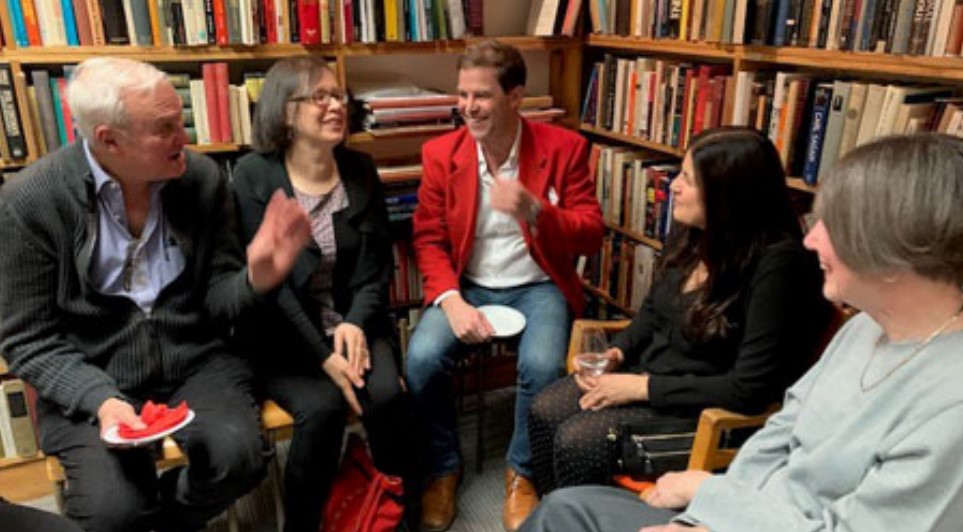
I love taking courses at Thomas More. And the thing that distinguishes leading from simply taking a course is—because you’re responsible for motivating the class discussion—that you have to read everything more carefully and think about it so you can come up with good questions, right? So for me that’s really a way to motivate myself to read everything much more closely, and I love that. And these are works that I always wanted to read […] but that I just wouldn’t read on my own. I think a few people mentioned this: it’s something that you want to be in a discussion group with other people about, because a lot of [these works] are harder than the average novel. As leaders, we come up with some discussion questions, and we make sure we know the text really well. But then, […] everybody is kind of feeding off of each other. So it’s very cool to see some of the discussions, some of the points that come up… things that you would never have thought of. And everybody sort of encourages everybody else to speak. People debate, but sort of in a gentle way.
If you were to describe the energy in the course to someone who has never been, how would you describe it?
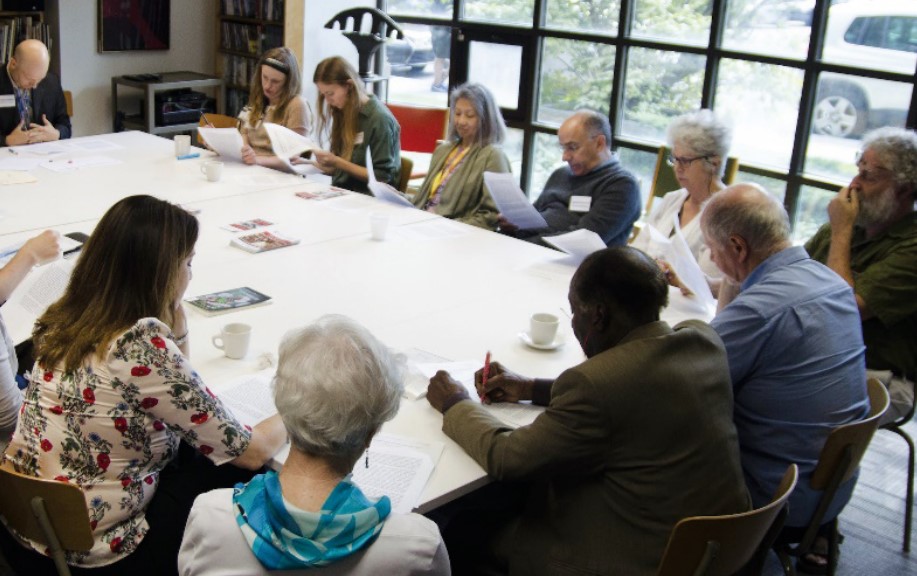
My first course at Thomas More, I had no idea it was going to be a discussion course. I just thought it was a seminar. It was Love in the Italian Renaissance, and I thought someone would be teaching the course and we would ask questions. So I was surprised when we all sit around a table, and the discussion sort of asked some provocative questions, and then everybody contributes their ideas and opinions. And so the energy in the room is amazing. Within the first two or three classes everyone gets to know each other and people tend to interact with each other’s questions, with the leaders’ questions… and so I think it’s a great energy.
What was your first impression of Milton in particular? Has that impression changed?
That’s a great question. I knew a little bit about Milton because I know of his background in the 17th century. Everybody knows Milton, including myself, for having written Paradise Lost, his most famous work. But I hadn’t realized how politically active he was in the government in the civil war that happened in England in the 17th century. So when Charles I was beheaded, [Milton] is an instrumental figure [who] works for the new Cromwell government, and is writing pamphlets that are in favour of regicide, in favour of divorce. So he spends a lot of his time, or most of his time during this period, just writing political tracks to help the new government. And then, of course […] Cromwell dies, and then Charles II is restored, and then Milton decides to go back to poetry. So that was really interesting. This political side of him was really interesting. And the other part that was really interesting was how much I enjoyed his poetry. You don’t necessarily think of Milton—at least I didn’t—as being a great poet, but when Joseph put the course together he included a number of [Milton’s] poems, and they were incredibly beautiful. So I was really happy to have been exposed to that and to have read them closely. Milton was very steeped in the classics, so there’s all kinds of allusions. It was very cool.
You are co-leading another course in the Winter, called Reading Virgil: Tensions in Roman Identity. Could you tell us a bit about it?
We’re going to be doing the Aeneid, which is [Virgil’s] most famous work of epic poetry. But in addition to that, we are going to be doing some of his other works. He wrote a bunch of pastoral poetry: the Eclogues, some beautiful stuff, and I think we’ll delve a little bit into the history. So I’m very excited to be leading that. And I think it’s going to be a great course.