MORE NEWS

History in Motion: Thomas More’s 80th Anniversary Fundraising Walk 

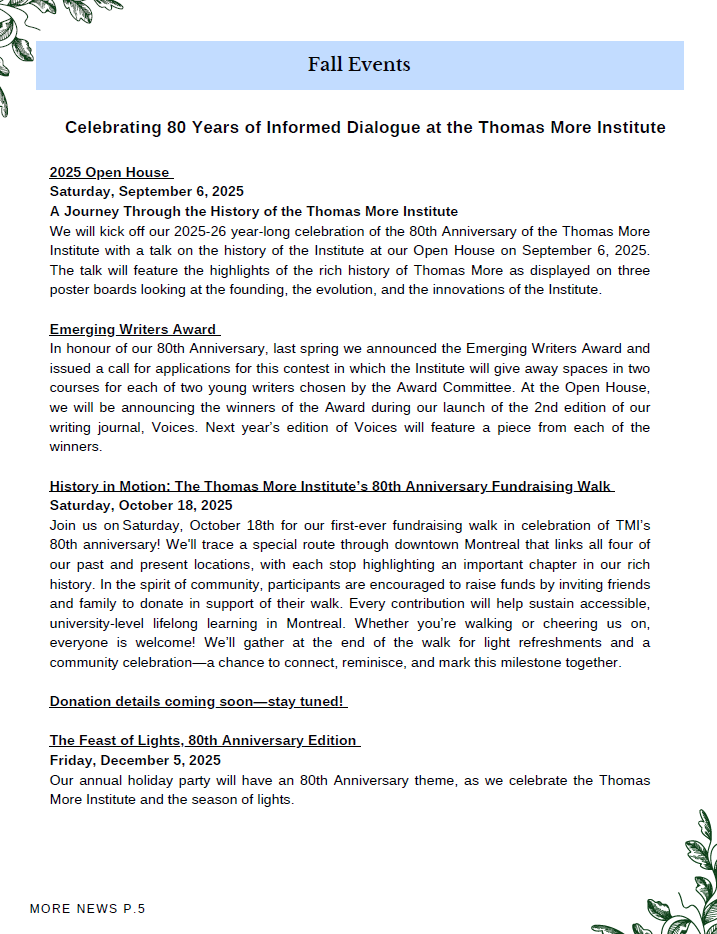
On Saturday, October 18, a group of 30 enthusiastic walkers met at D’Arcy McGee High School to trace the path that the Thomas More Institute’s rich history of education has travelled in the city. From D’Arcy McGee, where classes were held for many years at the beginning of our history, to Drummond Street, the second location where the Institute rented space, to our current location at 3405 Atwater, where we finally found a permanent home, the walkers celebrated 80 years of shared inquiry with a community of engaged, curious learners. Longtime students, leaders, designers, and administrators Heather Stephens and Irene Menear spoke at the first two locations, and current Chair Carol Fiedler wrapped up the event at our Atwater classrooms.  

The walkers not only enjoyed a lovely stroll on a cool fall day, but they also prepared for the event by spreading the word about the 80th anniversary of the Institute to family and friends, asking for donations to support Thomas More. When they arrived at the Atwater campus, they were greeted with warming, delicious coffee from the B Hive Café (2313 Ste-Catherine West, located in the Montreal Forum building) and delicious sandwiches from Chez Nick (1377 Greene Avenue, a longtime favourite restaurant of Thomas More students) and tasty sandwiches, fruit, and water from les 5 saisons (1280 Greene Avenue), our three generous sponsors for the event. 

As a fundraiser, the event far surpassed our expectations. When all donations were counted, the fundraising walk had raised $17,693 from 145 generous donors, 92 of whom were new to the Thomas More Community.  

A huge thank you to the walkers and other fundraisers for their dedication to Thomas More and for their willingness to ask friends and family to support this beloved institution dedicated to lifelong learning. We also want to thank our sponsors, the B Hive Café, Chez Nick, and Les 5 saisons for their support. Thanks also to our hospitality committee (Giovanna D’Alesio, Jennifer MacGregor, and Tina Nussbaum) for creating a wonderful welcome for the walkers at Thomas More. Finally, a huge thank you to our Manager of Development, Marleigh Greaney, who had the inspiration for the event and made it happen (down to ironing the Thomas More logo onto bandanas for the walkers).  


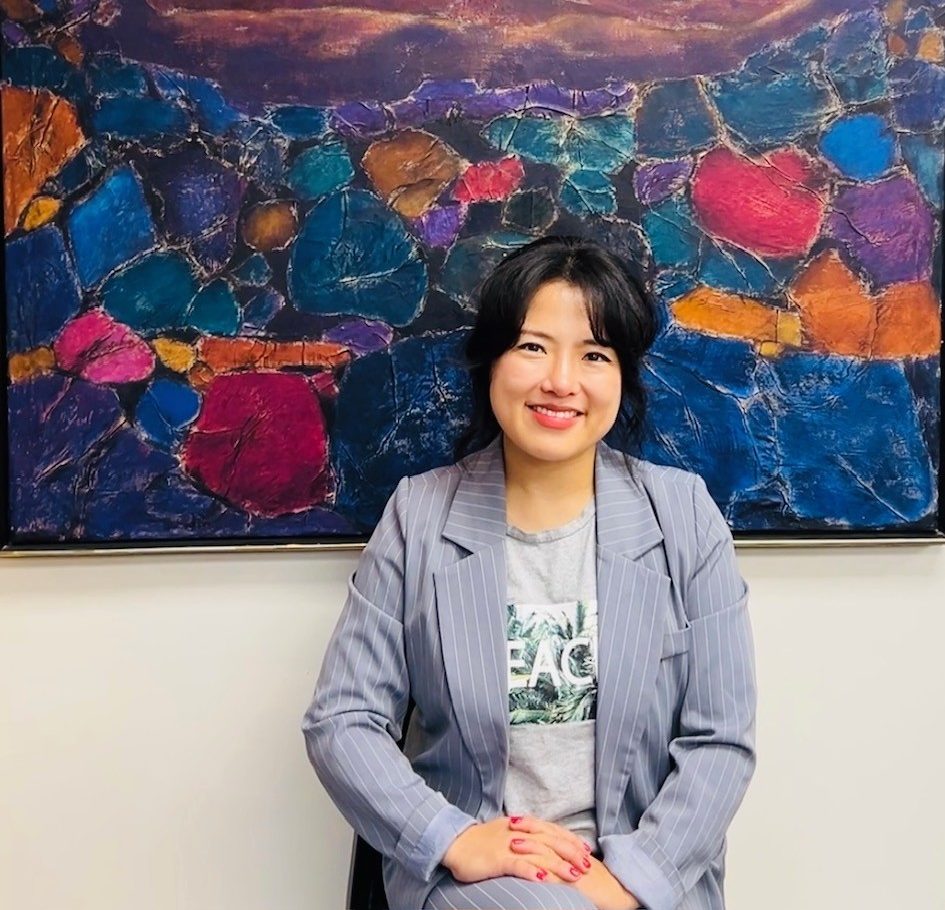
An Intergenerational Art Morning: Interview with Artist Saeun Song

A few weeks ahead of the Intergenerational Art Morning, the Thomas More Institute had the opportunity to sit down with Saeun Song, an artist from Toronto pursuing a Ph.D. at Concordia University in Montreal. An Intergenerational Art Morning will be held at the Thomas More Institute on Saturday November 8, from 10 a.m. to 1:00 p.m. and is an activity that aims to give parents/grand-parents and children an opportunity to bond by collaborating on making works of art. Song will guide the participants in a series of child-friendly workshops, and lunch for all will be served!

What do you love about teaching art?

That’s a great question! I love teaching art because art class is very dynamic and multi-dimensional. It’s never linear, never one-dimensional. Everyone brings their own experiences and backgrounds, and their own skillset, which requires me to be more flexible and give them spontaneous directions and responses, which makes art class really abundant and makes it come alive. There are lots of different ways of working in art class, and materials [you could work with] are unlimited, so this is what I love about teaching art because there is potential and tons of possibilities.

You’ve offered workshops in Korea, China, Lebanon, and other countries. What’s something you learned from interacting with kids from around the world?

My work is community-oriented, so I’ve worked and taught in many different countries, especially in under-privileged areas, where the concept of art education doesn’t exist or public art education is limited. But you know, art comes from human beings, so whenever I see them working on art, I can see that [the children] already have the key aspect of being an artist, like creativity. They don’t hesitate, they don’t set limitations for themselves, which is really inspiring, because as you grow up, you start to think too much, and worry about making a mistake, hesitating, but they never do that. So that’s something really fascinating to watch, and also, that’s something that I learned from them a lot.

What’s the most important lesson or experience you want kids to take away from their workshops?

I want them to have fun. Because this is an intergenerational workshop, they will have their parents and grandparents as a collaborator, not just as a supporter or helper, so I want them to have lots of conversation creating beautiful memories. Because when you grow up, when you think of your parents or grand-parents, you just look back at all the memories that you shared when you were young, so I want them to have this workshop as a good memory, so that they can cherish it throughout their lifetime.

What do you find interesting or valuable about adults and kids doing a workshop together?

Honestly, when I heard you guys were preparing this intergenerational workshop, I thought: Wow, this is exactly what we need these days. Because we live in a world dominated by  individualism, and families are often scattered, and they don’t have a real conversation under the same roof, even if they live together… So in that sense, I think this workshop is really meaningful, collaborating with your family members. So, I wouldn’t say collaboration is easy work—it’s actually a hard job, because you have to negotiate, communicate, and compromise, but at the end of the day, you will get a new perspective on each other, on different ways of working, or on the world. So this is really meaningful. And also, I believe they all bring different skill sets, which can lead to unexpected outcomes that would be really fun to witness. And I want them to have a really good conversation whenever they see the art, because art class will finish, but artwork remains forever.

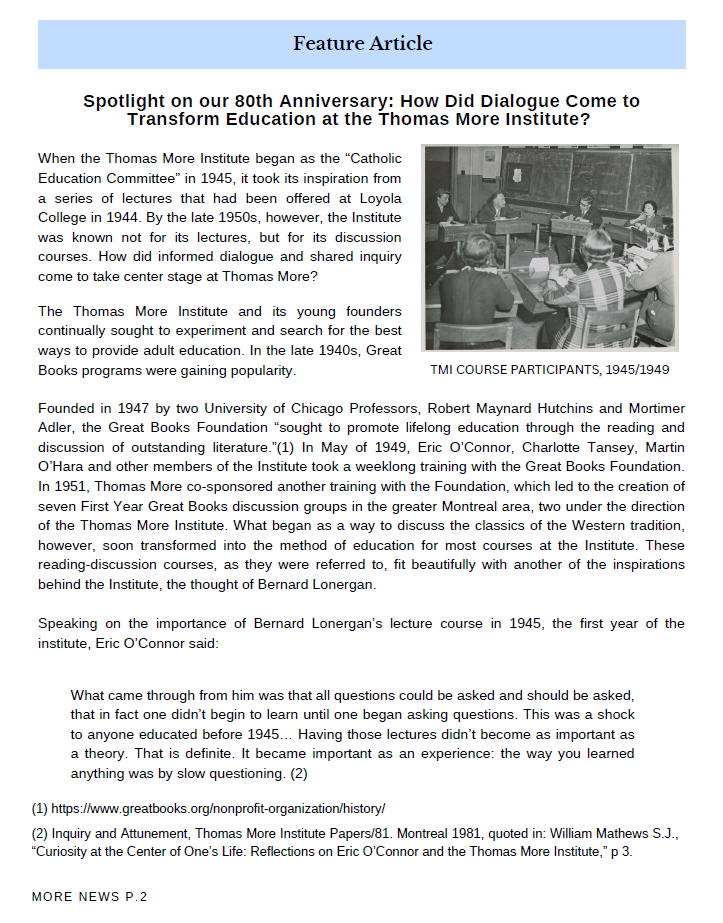
Spotlight on our 80th Anniversary: How Did Dialogue Come to Transform Education at the Thomas More Institute?

For our 80th anniversary, the More News will be publishing articles highlighting elements of our rich history.  

TMI Course, 1945/1949

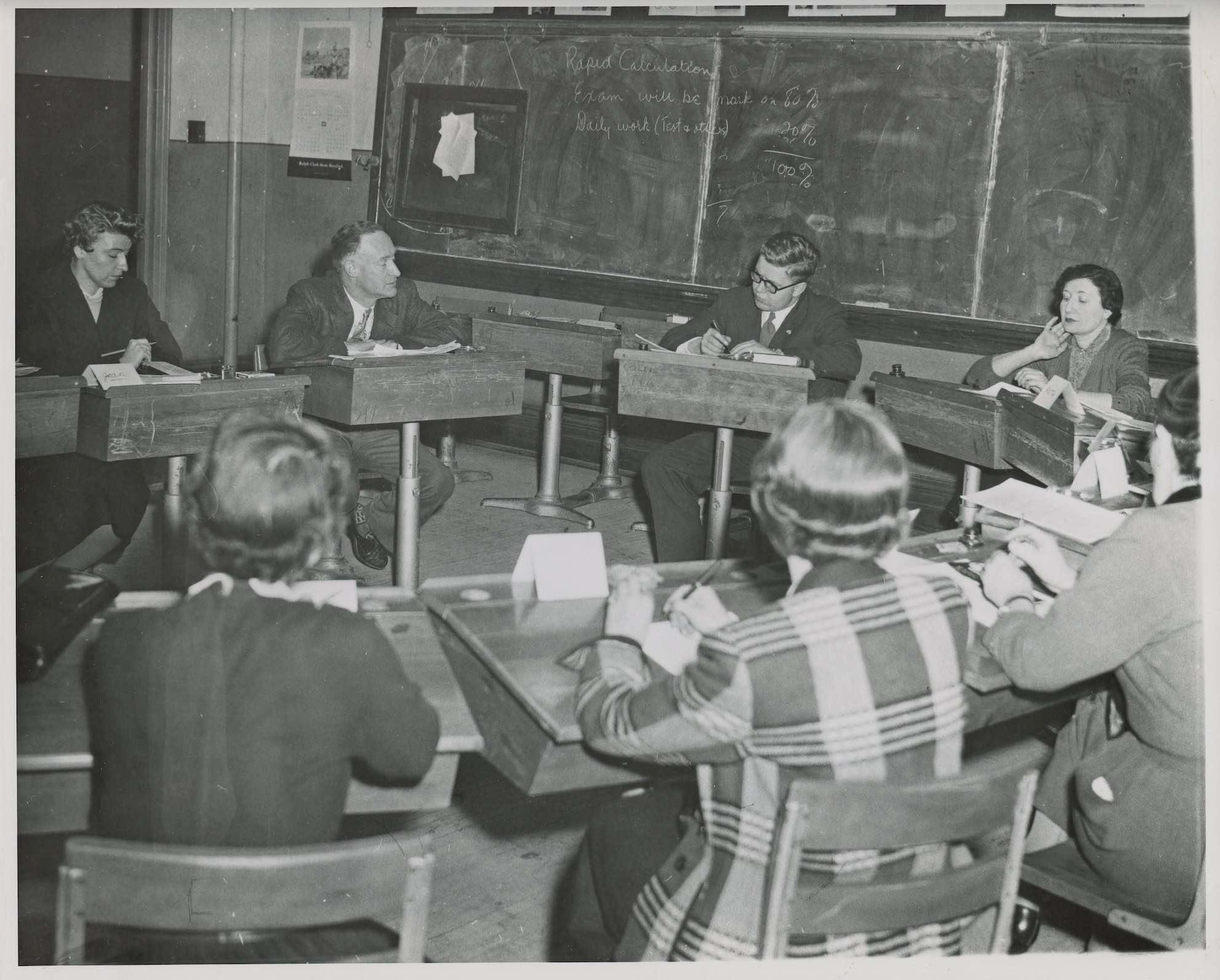
When the Thomas More Institute began as the “Catholic Education Committee” in 1945, it took its inspiration from a series of lectures that had been offered at Loyola College in 1944. By the late 1950s, however, the Institute was known not for its lectures, but for its discussion courses. How did informed dialogue and shared inquiry come to take center stage at Thomas More? 

The Thomas More Institute and its young founders continually sought to experiment and search for the best ways to provide adult education. In the late 1940s, Great Books programs were gaining popularity. Founded in 1947 by two University of Chicago Professors, Robert Maynard Hutchins and Mortimer Adler, the Great Books Foundation “sought to promote lifelong education through the reading and discussion of outstanding literature.”(1) In May of 1949, Eric O’Connor, Charlotte Tansey, Martin O’Hara and other members of the Institute took a weeklong training with the Great Books Foundation. In 1951, Thomas More co-sponsored another training with the Foundation, which led to the creation of seven First Year Great Books discussion groups in the greater Montreal area, two under the direction of the Thomas More Institute. What began as a way to discuss the classics of the Western tradition, however, soon transformed into the method of education for most courses at the Institute. These reading-discussion courses, as they were referred to, fit beautifully with another of the inspirations behind the Institute, the thought of Bernard Lonergan.  

Speaking on the importance of Bernard Lonergan’s lecture course in 1945, the first year of the institute, Eric O’Connor said:  

“What came through from him was that all questions could be asked and should be asked, that in fact one didn’t begin to learn until one began asking questions. This was a shock to anyone educated before 1945… Having those lectures didn’t become as important as a theory. That is definite. It became important as an experience: the way you learned anything was by slow questioning.” (2)

What reading-discussion courses sought to do was to create the experience of questioning in the classroom. Have you ever wondered why every description of a course at Thomas More is filled with questions? Thomas More discussion courses don’t push a particular point of view or seek to repeat the orthodoxies of a tradition. They inquire into the meaning of the texts read by the group and seek to understand them along with the questions of the course. As William Mathews put it in his article on the work of Eric O’Connor and the Thomas More Institute:  

“The Thomas More did not mean to question the correctness of the traditions, be they literary, religious, political, or cultural. The point was, had they been understood, what did they mean?… [It is mere] dogma that the world begins with “our generation” and the past, tradition, has nothing to teach us. The fact of the matter is that there is a wisdom in one’s past traditions, which properly assimilated equips a modern generation to understand, diagnose, interpret and respond to the pathologies and the creativities of the human spirit in its own era. Without the proper awakening of our questioning to the meaning and truth of our traditions and their wisdom figures we will be in bondage to them and become bigots. Or we will discard them and become rootless, be at the mercy of the whims of our present with no past wisdom to guide us.” (3)

One becomes an adult learner, a thinker, when one questions deeply and seeks to understand the thought of others, whether the classical great works or those of current writers. This in turn leads to one’s own insights about the world we live in. What is attempted in every reading-discussion course at the Thomas More Institute is to enable understanding to take place through shared inquiry into the questions of the course and the questions of our time.  

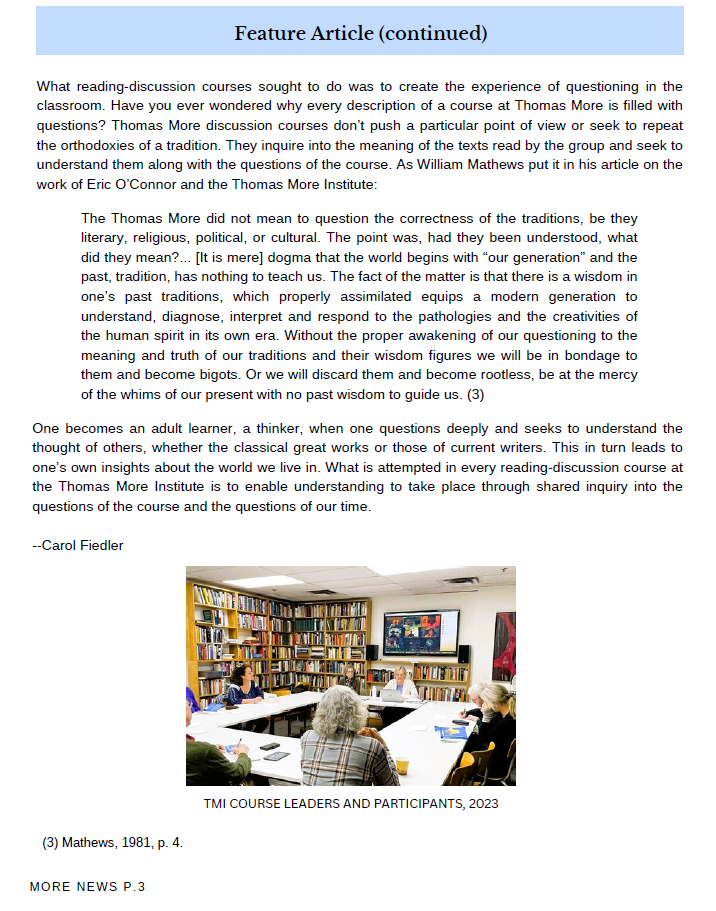
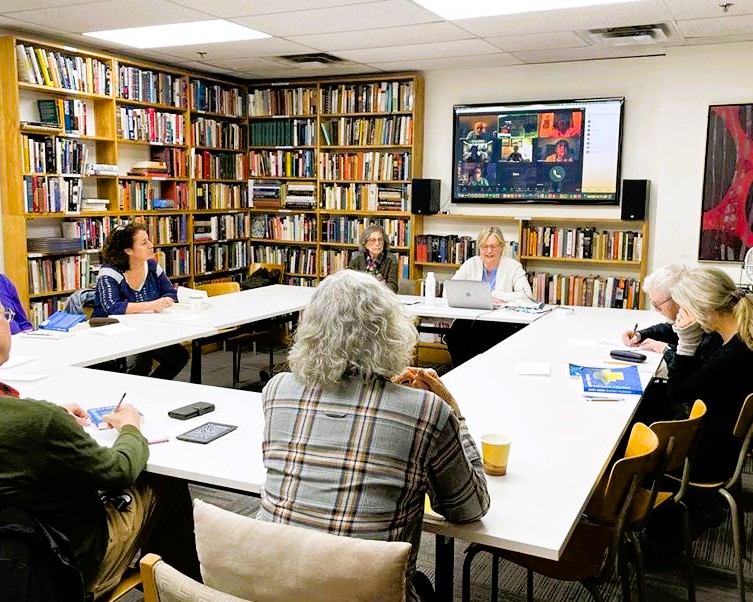
TMI Course, 2023

–Carol Fiedler 

(1) https://www.greatbooks.org/nonprofit-organization/history/

(2) Inquiry and Attunement, Thomas More Institute Papers/81. Montreal 1981, quoted in: William Mathews S.J.,
“Curiousity at the Center of One’s Life: Reflections on Eric O’Connor and the Thomas More Institute,” p 3.
(3) Mathews, 1981, p. 4.

A Word From the Chair: The Thomas More Institute at 80

A warm welcome to all as we embark on our 80th year as an institute of
higher learning where people come to take charge of their own education
and to learn in dialogue with others.

Eighty years ago, the founders of the Thomas More Institute responded to
a need. They set out to create a place where adults of all ages could pursue
university-level education in the post-World War II era. Many came to
Thomas More to work on a Bachelor of Arts Degree in the evening, while
others came to experience its vibrant intellectual culture, one where
thinkers such as Bernard Lonergan, Northrop Frye, Eric Voegelin, and
Eric O’Connor made important, stimulating contributions.
Today we are proud to continue that tradition and to fill another need,
that for a community of curious, intellectually serious adults in which
participants are invited to engage in thoughtful conversation, a meaningful
exchange of ideas, all guided by a curated curriculum that speaks both to
the issues of the day and to the perennial concerns of human beings.
This year, we will be looking back to our origins and ahead to our future.
We are proud to be a part of the vibrant cultural life of Montreal, a city
home to four major universities, known around the world as meeting
places for intellectual exchange.

In the pages that follow, you will see the rich offerings at Thomas More
this year: 33 newly designed reading-discussion courses, 8 instructor
courses in music, art, and writing, and 4 courses under the rubric TMI and
Our City, that invite us to bring our curiosity to some of the treasures our
wonderful city has to offer. In addition to this, keep an eye out for special
events this year as we celebrate our 80th anniversary and look forward to
a rich future ahead.

–Carol Fiedler
Chair, Board of Directors of the Thomas More Institute

Looking at the Academic Year Ahead: An Interview with Joseph Vietri, Manager of Academic Affairs and Operations

As the 2024-25 academic year winds down, MORE News had the opportunity to sit down with Joseph Vietri to get a taste of what TMI’s 2025-26 programming will look like. Read on for an exclusive look at the year ahead!

TMI often offers courses that relate to current events. Are there any this year that you feel are particularly timely?

One of the literature discussion courses coming up is “America Through the Looking-Glass: Questioning the U.S. as Superpower in Fiction”. I think many of the course’s topics, such as American identity and the narratives that exist around it, will resonate with people who are observing what’s happening in the U.S. currently. There will also be a social sciences course titled “Eastern Europe: An Out-of-Fashioned Idea?” which will offer lots of food for thought to anyone wanting to know more about recent events in Europe. And for an even broader perspective, the bilingual social science course “La défaite de l’occident?” will take a sharp look at some of the very foundations of Western civilization. Of course, these are just three of many courses—we will have many more on other subjects such as history, art and philosophy, just to name a few.

TMI is also known to offer various writing courses. Any sneak peeks you can give?

TMI has a very vibrant writing community, so we’ve planned several fun writing courses. One of them is “The Moments That Shape Our Lives”, a memoir course on writing about the transformative events in our lives. Another is “How to Finish Your Novel”, for writers who have unfinished novel drafts in the works. And finally, “Creative Writing: Hybrid Forms” will allow participants to explore the blending of different writing genres such as fiction, poetry, playwriting and others. I hope these courses will encourage writers to pursue their projects regardless of which stage they are at in the creative process.

Over the last few years, TMI has also been offering courses that allow participants to explore the city around them. What can we look forward to from these TMI and our City courses?

Our Discovering Art series will return with two new topics: “Discovering Art: The Rise of Landscapes”, and “Discovering Art: The Beginnings of Contemporary Art”. One of our walking tours will return for a second edition, so if anyone didn’t get a chance to take “Exploring Montreal’s Urban Nature” last year, this will be another opportunity to do so. And for those who love both art and walking, there will be a brand new course that combines both of these things: “The Art of Close Looking: Sketching at the Border of Shaughnessy Village and Westmount”.

Thank you for these special insights! We look forward to seeing the full list of courses, which will be revealed in the first week of July!


Filling in the Gaps: Lenore Beitel’s Pursuit of a B.A. at the Thomas More Institute


Lenore Beitel arrived at TMI with impressive credentials.  She held a PhD in Biochemistry from McGill, and had a professional career in molecular biology and genetics.  In her final working years, she was contributing to neuroscience research at the Montreal Neurological Institute.    

However, she had always been curious about other subjects as well, and wanted to know more about the world.  Her studies had left her little time for non-science subjects, but even as a student she had felt that something was missing, so after completing her BSc, she travelled around Europe for three months, visiting churches, museums and historic sites.  Once she started working, she continued to love travel, visiting places as diverse as Peru, Egypt, Jordan and Turkey.   

It was a natural step for a woman who had always shown such curiosity in her life to sign up for a course in Basic Essay Writing at TMI.  After the Essay course she chose one on Leonardo da Vinci.  “Leonardo da Vinci is my inspiration,” she says.  “Renaissance man, scientist and artist, and left-handed (like me).”  Unfortunately, that course was interrupted by the Covid pandemic, but Lenore was hooked. 

“I always liked school,” she tells me, “and I like the reward of getting a flat hat!” she adds, with a laugh.  She decided to apply for a B.A. degree, because she felt that the additional effort involved would be more rewarding.  “You learn so much more, going over the material, synthesizing it, and writing about it,” she explains. 

Her courses to date have ranged from The Bronze Age to Reading Machiavelli, Ancient Chinese Philosophy and A Stitch in Time: The History and Practice of Textile Arts.  Her quiet, thoughtful enthusiasm as she talks about the courses is palpable.  She has strong praise for many of her discussion leaders, and for the books and readings chosen.  She especially liked the way the textiles course included a visit to the Visual Arts Centre in Westmount, to learn about weaving in a practical way. 

However, some aspects of the TMI learning method were a bit of an adjustment for Lenore.  “I had no trouble with the reading, as I’ve always liked to read,” she says.  “But it took me a while to get used to expressing an opinion in the discussions.  I’m more of an introvert.”  Essay writing was another challenge.  In the sciences her papers were based on research, experiments and results, with a focus on the results.  She had more flexible deadlines and often worked with contributions from several people.   

“Writing in the humanities is more opinion-based, and you need to develop a thesis statement,” she says.  She found it challenging to link together a large variety of readings, and to meet fixed deadlines.  Lenore now sets herself goals of writing a certain number of words per day, and she has become more comfortable summarizing specific points from the readings.  She has also learned not to take too many courses with overlapping deadlines at the same time. 

After a rewarding career in the sciences, Lenore is thoroughly enjoying her new venture in the Liberal Arts world, bringing her into contact with other lifelong learners.  “I like the chance to get together with other people who want to learn.  I have met people who felt they were missing something, and studying the humanities filled a gap,” she says.  “I wasn’t expecting the range of viewpoints,” she adds.  “There are people in the classes from many different backgrounds, so we hear many different viewpoints.” 

She has some final advice for anybody who, like herself, might be interested in pursuing a B.A. at TMI, even if they already have an advanced degree in another field.  “Be curious.  Be open.  Share what you think.  Listen to other people.  Develop your writing skills.”  Lenore will graduate in about six more years.  After that?  “I’ll probably be back for different classes,” she says with a smile.  “And I’d be happy to mentor any new degree students.” 


– Pauline Beauchamp 

Pauline, together with colleague Karen Nesbitt, offered a very successful series of writing workshops at TMI in the 2010s.   

Interested in TMI’s degree program? You can learn more here, or make an appointment with Joseph Vietri, Manager of Academic Affairs and Operations. 


Anatomy of a Course Design: Linda Benguigui’s Courses

Anatomy of a Course Design: Linda Benguigui

by Imogen Brian, February 2025

Passionate about art and art history, Linda pursued a BA and an MA in art history. Her graduate studies led her to discover that, as much as she still loved art, the academic side of the subject wasn’t where she wanted to devote her energies. TMI has been the lucky beneficiary of Linda’s decision.

Since becoming involved with the Institute, she has designed three wonderfully imaginative, and very different, courses that make use of her knowledge of art, but present it to TMI classes in an inventive and appealing way.  

Looking at Art Through the Kaleidoscope of Colours 

Feeling that fact-based courses don’t lend themselves well to the TMI discussion method, Linda didn’t want to design a straightforward art history course. She started thinking that she’d like to design a course on colour. James Fox’s book The World According to Color: A Cultural History became the anchor for her thinking about the role of colour(s) in art, religion, and rituals. 

She knew right away that she wanted to show videos of artworks. She also wanted to include fiction, specifically short stories, that focused on colours (two she chose were Charlotte Perkins Gilman’s “The Yellow Wallpaper” and Poe’s “Black Cat”).  

The result of Linda’s vision and hard work was a course that appealed to different learners; those who were interested in the history and sociological and cultural meanings of colour, as well as those who just wanted to look at art, and colour. 

A Stitch in Time  

Keen to forge a relationship between TMI and the Visual Arts Centre, Joseph Vietri asked Linda if she’d be interested in collaborating with them on a course. Looking at their course catalogue, Linda decided to design a course to pair with theirs on weaving.  

As in her course on Colour, Linda chose a core book that was thematic rather than chronological. She supplemented the text, Kassia St Clair’s The Golden Thread: How Fabric Changed History, with fiction; excerpts from novels as well as a short story. 

The final two weeks of the course took the form of weaving sessions at the Visual Arts Centre where class participants wove on looms. 

Image above: Participant weaving projects from their sessions at the Visual Arts Centre

Repatriation of Cultural Artefacts: Ethical and Practical Considerations  

Linda’s third course, on the repatriation of cultural artefacts, is being offered this spring (Tuesdays, 1:30-3:30, Atwater, starting April 15 for six weeks).  

The core book for this course takes a conservative stance on the controversial issue. It focuses on (Western) museums, and on how they only sporadically return artefacts, arguing that the museums should keep them. The supplementary readings offer opposing viewpoints. 

The course will discuss well-known artefacts in the repatriation debate such as the Benin Bronzes and the Parthenon (or “Elgin”) Marbles. The Canadian situation, which is quite unique, will also be covered, since Indigenous peoples in Canada want to get their artefacts back in order to use them in ceremonies.